From idea to the App Store
iOS and Android apps designed around how your business actually runs — and games. We draw the screens, write the code, handle the store submission and maintain it after launch. Curious how we work? Our own app, Labyra Randevu, has been live on the App Store since 21 August 2026.
CepSalon
Live on the App Store
App Store
Our own app is live
iPhone + Watch
Two devices, one project
Push
APNs / FCM infrastructure
End to end
Design, code, store, maintenance
What kind of apps do we build?
These are two different crafts: one moves a business's daily operation onto a phone, the other builds something to be played. Both get the same care — but not the same process.
Apps that put your business in a pocket
Apps your team and your customers will actually use, shaped around your workflow. We don't drop a logo onto a template — we listen to how you work and build for that.
Scheduling & booking
Appointments, classes, tables, rooms or vehicles. Conflict checks, reminders and cancellation flows included.
Field & operations
Order picking, dispatch, courier tracking, stock counts and barcode scanning. Keeps working offline and syncs when the connection returns.
Customer loyalty
Digital membership cards, points, campaigns and coupons. Announce with a push instead of paying for SMS.
Staff app
Shifts, attendance, leave requests, task lists and approval flows — approvals happen on the manager's phone.
B2B ordering & catalog
Let dealers and wholesale customers browse and order from their phone, with stock and pricing coming from your system.
Manager dashboard in your pocket
Revenue, stock, bookings and alerts on one screen; critical approvals without sitting down at a computer.
Membership & content
Subscriptions, lessons and training content, announcements and messaging — all managed from a web panel.
A mobile face for your current system
A thin app that talks to your existing software's API and carries over only the screens you need.
Games whose feel is solved before the art
Making a game isn't putting art on top of an app; it's tuning how control feels in the hand. So we build a playable prototype before any art — if the mechanic doesn't land, no amount of polish saves it.
Casual & hyper-casual
Short-loop games learned with a single tap and played on the bus. Time-to-learn measured in seconds.
Rhythm & music games
Judgement is derived from the audio clock, not the render loop, so music and visuals never drift apart. That is exactly the problem we solved in our own rhythm-game prototype.
Puzzle & word
Level generation, difficulty curve and hint economy designed together, so one doesn't quietly break another.
Reflex & score-driven
Leaderboards, daily goals, streaks and progress saving — the parts that actually bring a player back.
Sound & haptics
Hit sounds, vibration feedback and music. A game's "feel" is mostly built here, not in the artwork.
Advergames
A branded mini-game for a trade fair, campaign or event. Short, shareable, with a leaderboard.
Level editor
So you can author content without touching code — new levels shouldn't require a new release.
Release & rating
Age rating, ads and purchase model, store artwork and a promo video, all included.
To be clear: our scope is 2D and casual titles. We don't produce large-scale 3D (AAA) games — we'd rather draw the line up front than overpromise.
CepSalon — live on the App Store
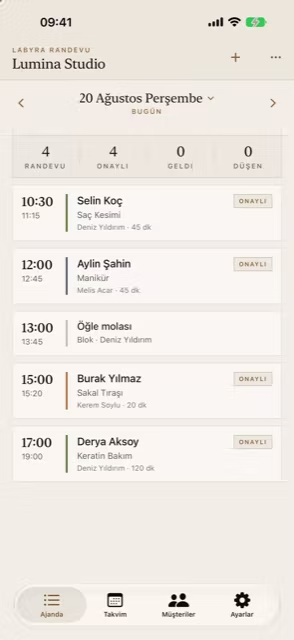
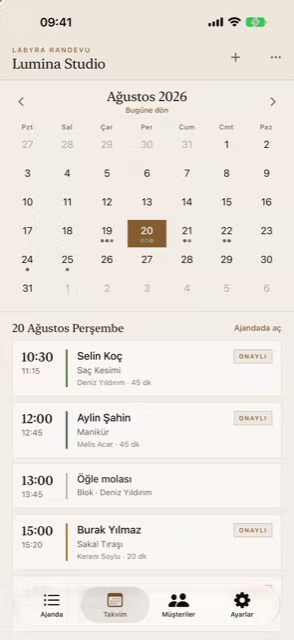
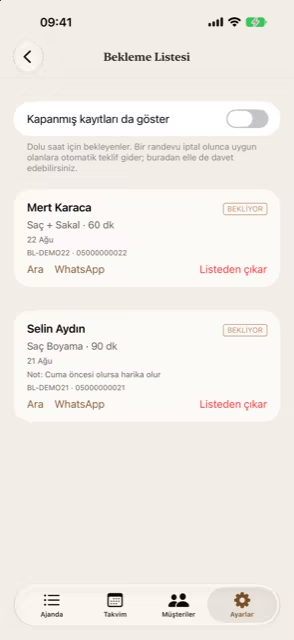
Instead of claiming "we do mobile too", here is the app we shipped. CepSalon (listed as Labyra Randevu in the current store version) is our app for managing the diary of appointment-based businesses; its next version also lets customers find a nearby salon and book. It passed Apple's review and went live on the App Store on 21 August 2026; the screens below are the real screenshots from its store listing.
Store
App Store · Business / Productivity
Release date
21 August 2026
Devices
iPhone + Apple Watch
Minimum OS
iOS 17
App size
4.5 MB
Age rating
4+
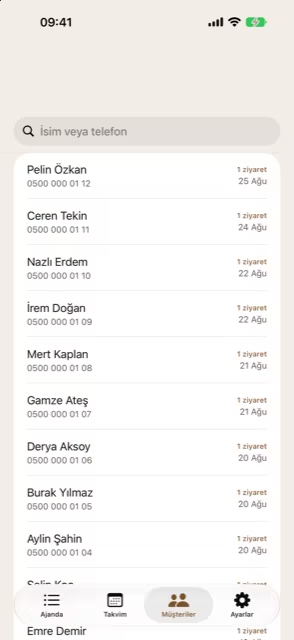
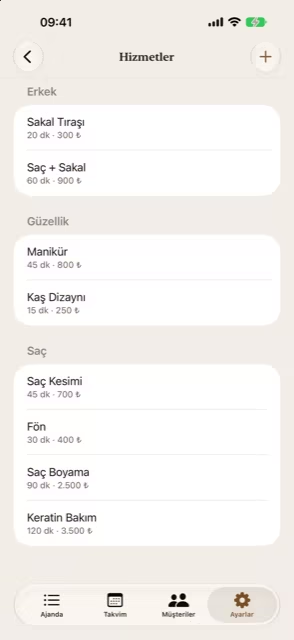
What we actually built
Native Swift + SwiftUI
The iPhone app and the Apple Watch app in a single project, including a watch-face complication showing the next appointment.
Push notifications (APNs)
New bookings and cancellations land instantly. For privacy compliance the notification carries no phone number, email or customer note — only time, service and an abbreviated name.
Row-level security
The database, not the client, decides which business sees which record. Even if the app asks for "my salon", the database enforces its own rule.
One source of truth for rules
Conflict checks, email and calendar-file generation stay in a single web service and were never copied into the app. Logic that drifts apart in two places is the most expensive kind of bug.
From TestFlight to the store
Beta distribution on real devices first, then store review — privacy labels, encryption declaration and a reviewer account included.
No download for the customer
The app is for the business; customers book from the browser. We never make anyone "install our app first" — nothing kills conversion faster.
Screenshots are taken from the App Store listing; the salon name and customer details shown are demo data for illustration and do not belong to real people.
Native or a single codebase?
We do both; the choice depends on the project. We don't decide for you and then explain it away afterwards — the reasoning behind our recommendation is written into the proposal.
Native (Swift / Kotlin)
When the app reaches into system capabilities — Apple Watch, widgets, camera and barcode scanning, background location, live activities — or when one platform needs the best possible feel.
- Full access to every device capability
- The smoothest animation and the most native feel
- Each platform is built separately → longer timeline, higher budget
Single codebase (React Native / Expo)
When you want to launch on iOS and Android at once, the app is mostly lists, forms and screens, and budget and timeline are the deciding factors.
- iOS and Android ship together
- Noticeably shorter timeline and lower budget
- Very specific system capabilities can add extra work
The tools we use
The invisible half of an app
A mobile app can't stand alone: it needs somewhere to keep the data, a panel where you manage content, a service that sends the notifications, and the legal pages the stores require. These aren't extras — they're half the job, and they're in the quote.
Data & authorization
On PostgreSQL, with record ownership defined at the database level. Servers are in the European Union (Frankfurt).
Web admin panel
Where you manage content, users, prices and settings. Written by the same team as the app, so you're never caught between two vendors.
Notification infrastructure
APNs for iOS and FCM for Android through a single path — instant alerts as well as scheduled reminders.
The pages stores require
Privacy policy, data-protection notice, and account deletion both in-app and on the web. Without these, the stores won't publish the app.
From idea to launch: 6 steps
Every step ends with something tangible. There's no "you'll see it when it's done" — each round puts something working on your phone.
Discovery & scope
We write down who opens the app, at what moment, to solve which problem. Scope is trimmed here; the most expensive feature is the one added later.
Output
Scope & screen list
Flow & design
Screens and the transitions between them. We don't start coding until you've approved a clickable design.
Output
Clickable design
Development
Two-week rounds. Every round ends with a build you can install on your phone.
Output
Working build
Testing on real devices
TestFlight on iOS, closed testing on Android — on your team's actual phones. Notifications, permissions and real data get exercised here.
Output
Beta distribution
Store release
Account, icon, store artwork, listing copy, privacy labels, age rating and the review correspondence. If it's rejected, we write the response.
Output
A published app
Maintenance & releases
OS updates, store policy changes, bug fixes and new feature rounds. An app isn't finished on launch day.
Output
Release plan
What gets apps rejected?
The hidden cost of a mobile app is store policy, and it's where most projects collect their first rejection. The items we hit most often, and how we handle them:
In-app account deletion
Apple requires that any app with accounts lets the user delete theirs from inside the app. We don't hunt for an exemption because an admin created the account — the flow ships in v1.
Web-based account deletion
Google Play additionally requires a deletion page reachable from a browser, outside the app. We add it to your website.
Moderation when there's user content
If users can send each other messages or content, Apple looks for four things at once: reporting, blocking, moderation and a visible contact address.
Closed testing on new Play accounts
New individual developer accounts must run an uninterrupted closed test with a set number of testers before applying for production. That's why the Play account is opened on day one, not at the end.
Current target API level (Android)
Play requires new apps to target a current API level, and that bar rises every year. We build against the current level from the first compile.
Privacy labels & data safety form
What you collect, who you share it with and why. The store form and your privacy policy have to agree — when they don't, the app comes back.
Age rating
If the questionnaire doesn't match the content, the app is rejected. Especially critical for games and anything with chat — AI-generated content is assessed separately.
Encryption declaration
Marking the declaration correctly for ordinary HTTPS speeds up review and stops the same question from reappearing on every release.
These items are accurate as of 24 August 2026. Apple and Google revise their policies several times a year; we check the current version together at the start of your project.
What's in the quote?
Mobile work is often handed over as "we wrote the code, the rest is yours". For us, delivery is the moment the app is downloadable from the store.
- Product flow and screen design
- iOS and/or Android app
- Database, authorization and API
- Web admin panel
- Push notification infrastructure
- App icon and store artwork
- Store listing copy and keywords
- Privacy policy, data notice and account deletion flow
- Store submission and review correspondence
- Post-launch maintenance plan
- Handover of the source code and store account to you
Who do we build for?
The common thread isn't an industry, it's a process: if you have repetitive work tracked by hand, asked over the phone or written in a notebook, a mobile app earns its keep.
Mobile apps are quoted per project
Screen count, platform (iOS / Android / both) and the need for notifications and a panel set the budget. We nail down the scope together and give a fixed-price quote. Store account fees (Apple annual, Google one-time) belong to you directly and are itemised separately.
Frequently asked
How long until my app is live?
It depends on scope. For a focused business app the typical range is 5-8 weeks, covering design, development, testing on real devices and store review. If a new Android developer account is needed, Google's mandatory closed-testing period is added to the schedule. We commit to a specific timeline at the end of discovery, once scope is fixed.
iOS or Android first?
If budget is tight we suggest starting with one platform and testing with real users — start wherever most of your customers already are. With a single codebase both ship together. We started with iOS on our own app too.
Whose name is the store account in?
Yours. The app is published under your identity and you own the account; we get developer access. Apple Developer Program is an annual fee, Google Play Console a one-time fee, and both are paid from your account — so the app is never tied to us.
Do you really make games too?
Yes — casual, rhythm, puzzle and score-driven 2D games. In a game the mechanic is the whole job: how control feels, the difficulty curve, and the sound and haptic feedback. That's why we build a playable prototype before any art. Large-scale 3D (AAA) production is outside our scope, and we say so upfront.
Do I own the source code?
Yes. When the project ends, the source code, the database and the store account are yours, handed over with a transfer document. We're happy to keep maintaining it, and if you'd rather not, another team can pick it up. We don't lock anyone in technically.
Does the app need a server?
Almost every app needs a database and an admin panel, and we set those up too. Monthly infrastructure cost is very low for small apps and is written into the quote with an estimated figure, so there are no surprises later.
What happens after launch?
We continue with a maintenance plan: iOS and Android OS updates, store policy changes, bug fixes and new feature rounds. Unmaintained apps can fall out of the store within a year or two as policies shift — preventing that is what maintenance is really for.
I already have a system — can the app connect to it?
It can. We build apps that talk to systems with an API (booking, ERP, e-commerce, accounting, inventory). If your system has no API, we write the service that's needed and show it as a separate line item in the quote.
Tell us about the app you have in mind
A business app or a game — tell us the idea and we'll write back a clear scope, timeline and budget. If we think the idea doesn't warrant an app, we'll say that too.